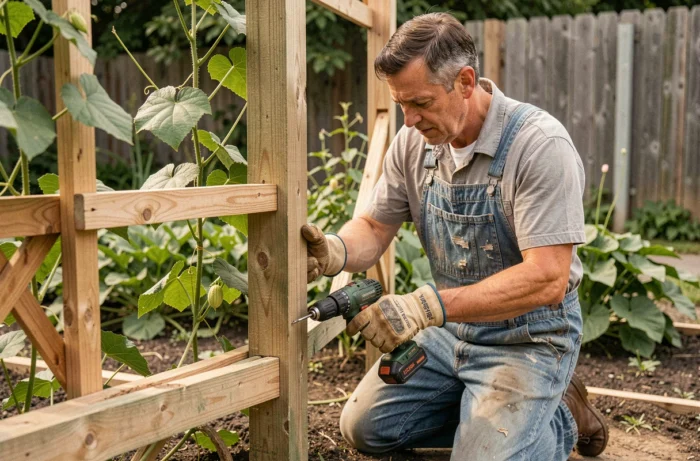
The kiwi (Actinidia) is a vigorous vine whose foliage and fruits exert a considerable load on any support. Designing the structure as a lightweight framework, rather than just a decorative trellis, is crucial for both the longevity of the installation and the quality of the harvest.
Load Calculation and Wind Resistance for a Kiwi Structure
A kiwi structure supports three types of simultaneous stresses: the weight of the branches and foliage, the load of ripe fruits, and the wind resistance of a dense, wet canopy. Ignoring any of these three components leads to sagging by the third or fourth year of production.
We recommend not exceeding 5 to 6 m between two supporting posts when they directly support the wires and branches. Beyond this, the bending under gusts combined with the weight of wet foliage causes permanent deformation of the crossbars, even on generous sections.
In a T-bar configuration (horizontal beam fixed at the top of the post), the commonly accepted spacing is around 4.5 m. This distance limits the deflection on the taut wires and facilitates maintenance, as branches can be accessed without a tall ladder. For those looking to build a kiwi structure at a lower cost, reducing the spacing also allows for smaller wood sections, which partially offsets the extra cost of additional posts.
Bracing and Cross Bracing
The braces (diagonal reinforcements between the post and the crossbar) are not an aesthetic luxury. They transform a bending assembly into an indestructible triangle. Without them, the crossbar gradually tilts under the asymmetric weight of the branches, especially when the wind pushes along the row.
On a wooden setup, a brace with the same section as the crossbar, cut at 45°, screwed with galvanized or stainless steel screws, is sufficient to stiffen the whole structure. Each post must support at least two symmetrical braces to withstand lateral forces from both sides.
Material Selection: Posts, Wires, and Fasteners for Kiwi Training
The materials section represents the main trade-off between immediate economy and durability. Three types of posts are commonly used in setups: treated wood, galvanized metal, and precast concrete.
- Treated class 4 wood remains the most accessible in terms of cost and tooling. Its limitation: a variable lifespan depending on the species and quality of treatment, with a risk of rot at the base if drainage is insufficient.
- Galvanized steel tubing (round or square) offers superior rigidity at equal section and better resists the permanent moisture at the base of the post. The extra cost is justified for long or wind-exposed structures.
- Concrete posts, economical to purchase, are heavy and complicate adjustments. We reserve them for permanent installations where the placement is certain.
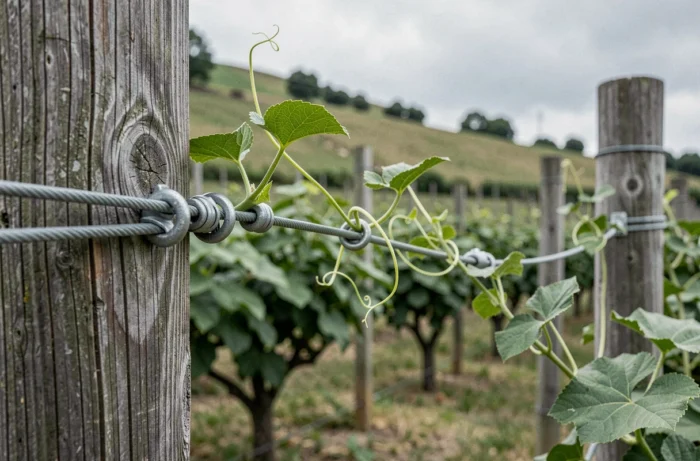
Tensioned metal cables are a better replacement for natural or synthetic ropes. A rope relaxes under humidity and deteriorates in a few seasons, while a galvanized steel wire maintains its tension for years with a simple end-of-row tensioner.
Fasteners and Assemblies
All hardware exposed to the elements must be hot-dip galvanized or stainless steel. Exterior screws (such as framing screws with washers) are preferable to nails and nut bolts, as they allow for gradual tightening and disassembly without destruction.
Using metal post feet set in concrete rather than directly burying wood protects the base from rot and facilitates future replacement.

Arrangement of Male and Female Actinidia on the Structure
Kiwi pollination imposes a planting constraint that the structure must integrate from the design stage. Actinidia is a dioecious plant: male plants produce pollen, while female plants bear fruit. One male plant can pollinate several female plants, provided that wind or insects can effectively carry the pollen.
In practice, we place the male plant at the center or at the head of the row, facing the prevailing winds, so that the pollen disperses towards the downstream female plants. One male for five to eight female plants is a common ratio in trained orchards.
The T-bar structure lends itself well to this arrangement: each post hosts one plant, and the supporting wires guide the branches horizontally along the crossbar. The fruiting branches of the females then hang freely, facilitating harvest and air circulation around the fruits.
Spacing Between Plants and Training of Branches
Too tight spacing between plants leads to entanglement of branches, complicating pruning and promoting stagnant humidity. Allowing sufficient distance between each plant enables the branches to be trained in a fan shape without excessive overlap.
The training wires (three parallel wires on the horizontal crossbar) serve as guides. Branches are tied with soft ties to avoid strangling the wood as the section grows.
Maintenance of the Structure and Kiwi Pruning: What Determines Longevity
A properly sized structure does not exempt from regular maintenance. The tension of the wires must be checked at the end of each winter, before the vegetative resumption, as a loose wire allows branches to sag and concentrates the load on the attachment points.
Winter pruning of the kiwi is not just a fruit operation: it directly lightens the load on the structure. Removing branches that have fruited and shortening extensions limits the weight supported by the wires and crossbars during the following season.
- Check the condition of the post bases (corrosion, rot) at each pruning.
- Retighten the cables with the lantern tensioner as soon as a visible deflection appears between two posts.
- Replace soft ties that begin to cut into the bark of the branches, to prevent entry points for diseases.
A well-conducted training distributes the load evenly along the length of the crossbar. Conversely, allowing the vine to colonize one side creates a lever arm that stresses the braces beyond their capacity.
The longevity of a kiwi structure depends as much on its initial design as on the care taken each year in training and pruning. A simple setup, with appropriately sized sections, durable fasteners, and methodical maintenance, lasts much longer than an oversized but neglected installation.