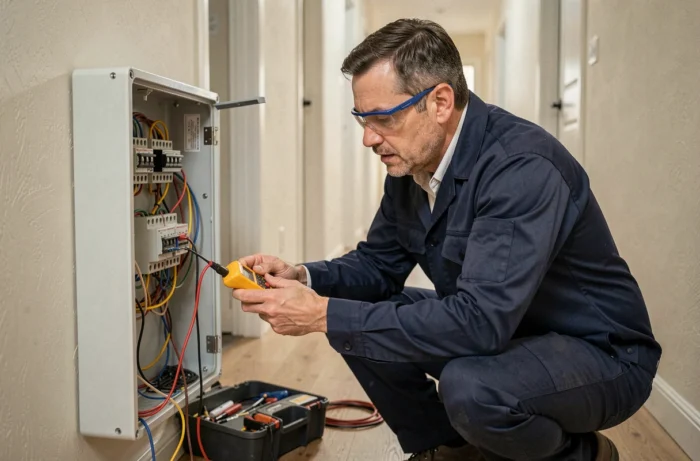
A power outage on a Sunday evening, a circuit breaker that refuses to stay on, a wall socket emitting a suspicious smell. These situations prompt a hurried search for an electrician. However, in several cases, the problem does not require a private contractor, and a misdirected call results in an unnecessary service charge.
Electrical failure: is it really up to an electrician to intervene?
Before picking up the phone, a quick check can help identify three sources of failure. The first, and most common, concerns the public network. If your neighbors are also in the dark, the network manager (Enedis in most cases) is the only competent contact. Their emergency number is listed on your electricity bill. No private electrician can intervene on the public network, and calling a contractor for a network outage does not solve anything.
The second source is a simple tripped circuit breaker. You may have plugged in too many devices on the same circuit, or a faulty appliance has caused a short circuit. In this case, unplug the suspicious devices, then reset the circuit breaker. If it stays on, the problem is resolved without intervention.
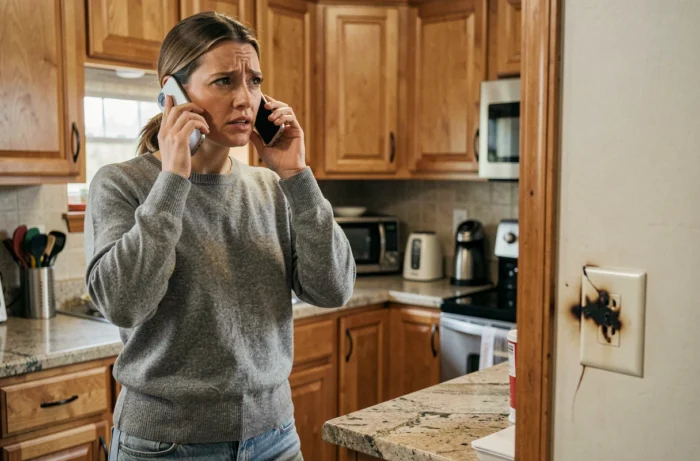
The third situation justifies a professional: a burnt smell near the electrical panel, visible sparks, exposed wires, or a circuit breaker that repeatedly trips without an identifiable cause. To guide your search for a responsive professional, a useful resource is: https://www.vite-un-electricien.com/, which connects you with electricians available quickly.
Mandatory quote and ten-year insurance: two checks before any intervention
Haste often leads to accepting that a contractor starts work as soon as they arrive. This is a costly mistake. An written estimate is mandatory before intervention for home repairs, including in emergencies, with no minimum amount to be respected. An electrician who refuses to provide an estimate before touching your installation is violating regulations.
This estimate must detail the planned operations, the price of parts and labor, as well as travel expenses. Demand it in writing, even on a smartphone. A serious professional will provide it without hesitation.
Ten-year insurance: repair or work on the structure?
You may have noticed that some contractors display ten-year insurance while others do not? The distinction is technical but directly protects you. A simple repair (socket replacement, circuit breaker reset) does not fall under ten-year warranty. However, as soon as the intervention involves the installation integrated into the structure (replacement of the electrical panel, installation of new embedded cables), ten-year insurance becomes mandatory.
Request the insurance certificate before the work begins, not after the invoice. A contractor who refuses to show it exposes you to financial risk in case of poor workmanship.
Telemarketing and scams in electrical repairs
Since August 2026, unsolicited commercial calls are prohibited without prior explicit consent. This ban also covers SMS, emails, and messages on social networks. An electrician who contacts you by phone without your request is operating illegally.
This crackdown directly targets repair scams, a sector particularly affected. The classic scenario: a contractor found at the top of sponsored results charges a very high service fee, inflates the diagnosis, and then performs unnecessary repairs.
To avoid this trap, here are three concrete reflexes:
- Check that the company has an active SIRET number, which can be consulted for free on public business directories.
- Read online reviews on several different platforms, not just the contractor’s own. Be wary of profiles with exclusively maximum ratings and generic comments.
- Compare at least two estimates before accepting an intervention, even in an emergency. The time it takes to receive a second estimate by phone is often enough to spot an abnormal price.
Concrete criteria for choosing a reliable emergency electrician
Beyond price, several elements separate a competent professional from a dubious contractor. The Qualifelec qualification or an equivalent mention certifies verified competence by an independent organization. This is not a commercial label: it is a technical evaluation renewed periodically.
Geographical proximity also plays a role. An electrician located less than thirty minutes from your home will respond faster and charge lower travel fees. Geolocated matchmaking platforms automatically filter by area, speeding up the search.
What the invoice should contain after intervention
Once the repair is completed, the invoice must reflect the elements of the initial estimate. Check these points:
- The details of the replaced parts with their reference and unit price.
- The billed labor time, consistent with the actual duration of the intervention.
- The travel expenses, identical to those announced in the estimate.
- The company’s SIRET number and mention of its professional insurance.
Any discrepancy between the signed estimate and the final invoice constitutes grounds for dispute. Keep both documents.
A good reflex beforehand avoids the majority of bad experiences: identify the true nature of the failure, check the estimate and insurance, then compare. These three steps take less time than a dispute with a less scrupulous contractor, even when the situation seems urgent.