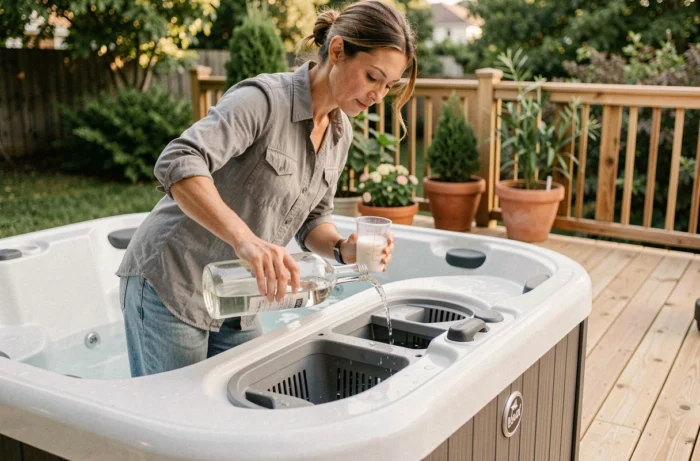
White vinegar with 8% acetic acid attacks limescale deposits, that’s a given. Its use in a spa poses problems that most general guides dismiss with a single line of warning. We will detail the points that require genuine technical vigilance, particularly the nature of the joints, pH instability, and limitations regarding biofilm.
White vinegar and spa joints: risk of porosity depending on the material
On a one-piece acrylic tub, brief contact with diluted vinegar does not pose major difficulties. The problem arises as soon as the spa has tiled coping, a masonry step, or an adjacent deck with cement joints.
Acetic acid gradually dissolves the binder in cement joints, making them porous and crumbly. This phenomenon intensifies with each application. Within a few months of regular use, the joint loses its cohesion and becomes a breeding ground for mold, even leading to infiltration under the coping.
Silicone and epoxy joints tolerate acidity better, provided that the contact time remains short and rinsing is immediate. Before spraying vinegar around the spa, we recommend identifying the type of joint present. A simple test: lightly scratch with your nail. A cement joint crumbles, while an epoxy joint resists. This check prevents costly repairs on the spa’s periphery.
When one wishes to use dkomdecofr for their spa, this distinction between materials is the first reflex to adopt before any handling.
pH correction with vinegar: a false good idea for the spa
Some owners pour white vinegar directly into the tub to lower a too-high pH. On paper, acetic acid does indeed reduce pH. In practice, the effect is fleeting and difficult to control.
Acetic acid is a weak acid with limited buffering capacity. The pH drops quickly after addition, then rises again within a few hours due to CO₂ outgassing and the high water temperature. The result: pH fluctuations that stress equipment and disrupt disinfectant effectiveness.
pH correctors formulated for spas (pH minus based on sodium bisulfate, for example) offer stable and measurable action. Vinegar, on the other hand, introduces organic matter into the water. This organic load feeds bacteria and increases disinfectant demand. We regularly observe cloudy water in users who correct their pH with vinegar rather than with a suitable product.
Total alkalinity and vinegar: a often forgotten parameter
Vinegar also lowers total alkalinity (TA), which further destabilizes pH over time. In a heated spa, where temperature accelerates all chemical processes, this drop in TA causes an unstable pH, sometimes corrosive to the heater and pump joints. Water treatment professionals for pools and spas consider vinegar an ineffective and unstable pH corrector, to be reserved exclusively for cleaning out of water.
White vinegar against biofilm in the plumbing: concrete limits
Biofilm, this slimy layer of microorganisms that coats the inside of pipes, constitutes the real sanitary challenge of a spa. White vinegar does not have the ability to dislodge it.
Acetic acid does not penetrate the biofilm matrix. It acts on the surface on limescale but does not penetrate the polymer structure that bacteria secrete to protect themselves. Rinsing with vinegar gives the impression of clean plumbing because mineral deposits disappear, while the biological layer remains intact underneath.
To treat biofilm, one must resort to a pipe cleaner formulated with oxidizing or enzymatic agents, applied during the quarterly draining. Vinegar can complement this operation by removing residual limescale after the anti-biofilm treatment, but it does not replace it.
- Oxidizing or enzymatic pipe cleaner: the only product capable of disaggregating the biofilm matrix before draining
- Diluted white vinegar: useful in a second pass to dissolve limescale deposits released by the cleaner
- Abundant rinsing with clear water: mandatory after each treatment to eliminate any acidic residue before refilling
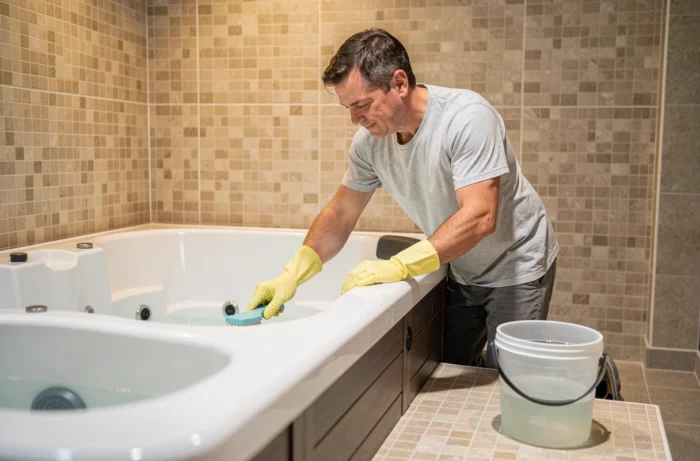
Areas and uses where white vinegar remains relevant in a spa
Vinegar retains real interest for cleaning surfaces out of water, provided that a few rules of dilution and contact time are respected.
Waterline and acrylic shell
The waterline accumulates a mix of limescale, body grease, and sunscreen residue. A microfiber cloth soaked in diluted white vinegar (about one volume of vinegar to two volumes of water) removes this deposit without scratching the acrylic. Never use an abrasive sponge: micro-scratches become areas for bacterial colonization.
Thermal cover and headrest
The inside face of the cover and the headrests accumulate mold related to condensation. Pure white vinegar, applied with a spray and wiped after a few minutes, treats these superficial molds. Careful rinsing prevents residual acidity from falling back into the spa water during the next use.
Soaking filters: a regulated use
Soaking a cartridge filter in a solution of white vinegar for several hours dissolves the limescale embedded in the folds. This method works on mineral deposits but does not replace a degreasing filter cleaner to eliminate organic residues (sebum, oils). The ideal: alternate a vinegar soak and a degreasing soak, spacing the two treatments.
- Waterline: diluted vinegar, microfiber cloth, immediate rinsing
- Cover and headrest: pure vinegar in spray, wiping then rinsing
- Cartridge filter: soaking in diluted solution, alternating with a dedicated degreaser
- Drained tub: passing vinegar after the pipe cleaner, never as a replacement
White vinegar remains a maintenance ally for the spa, but confined to mechanical cleaning of surfaces and occasional descaling. As soon as it comes to water treatment, chemical correction, or combating biofilm, other products take over. Confusing surface cleaner and water treatment product is the most common and damaging mistake for the longevity of equipment.