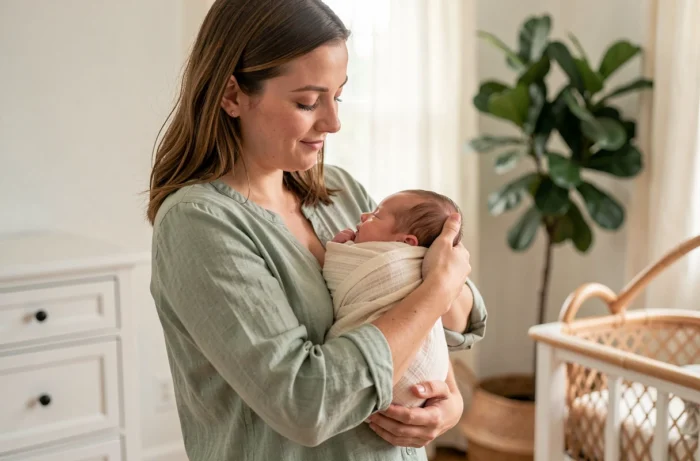
Welcoming a baby in its first months requires parental skills that develop quickly, but not always based on the right benchmarks. We observe that the available content focuses on material preparation or the layette, to the detriment of perinatal health measures and the physiological signals to monitor in both the infant and the mother.
Mandatory Postnatal Check-ups: An Underutilized Right to Support Baby and Parents
Since their generalization, early postnatal check-ups remain largely unknown to families. These consultations, conducted by a midwife or a doctor, are designed to early identify psychological difficulties, isolation, or precarious living conditions during the first weeks after birth.
Data from Santé publique France published in 2026 confirm the extent of the problem: about 17% of women exhibit depressive symptoms two months postpartum, 27% show anxiety symptoms, and 5.5% report suicidal thoughts. These figures vary significantly by region, with nearly 30% of depressive symptoms in Guadeloupe compared to 17% in mainland France.
We recommend that parents explicitly request these check-ups if the maternity ward or the healthcare professional does not spontaneously offer them. Preparing a list of questions about the infant’s sleep, persistent pain, the experience of childbirth, or any feelings of isolation can help maximize the benefits of these consultations. The guidelines that structure the baby page on Excargot cover some of these care and development themes.

Post-Traumatic Stress Related to Childbirth: Identifying Signs in the First Months
Vaginal delivery can generate lasting post-traumatic stress. According to a study conducted by CRESS (UMR 1153), about one in twenty women develops persistent post-traumatic stress after a vaginal birth. This disorder differs from the baby blues by its duration, intensity, and specific manifestations.
Signs to monitor in the mother during the first months:
- Intrusive flashbacks of childbirth (images, recurring nightmares) that do not diminish after the first weeks
- Marked avoidance of anything that reminds her of the birth, including the infant’s medical appointments or discussions about motherhood
- Disproportionate hypervigilance around the baby, with sleep disturbances independent of the infant’s awakenings
- Emotional detachment or difficulty bonding with the child, sometimes confused with ordinary fatigue
This clinical picture remains underdiagnosed in France. The aforementioned postnatal check-ups provide the ideal framework to address these symptoms, provided that the healthcare professional asks the right questions. If not, naming the problem oneself accelerates the care process.
Perinatal Health in France: Territorial Fragilities Affecting Infant Care
A report from IGAS on the organization of perinatal care in the regions highlights major disparities in access to postnatal care. The public health logic remains insufficiently asserted in several areas, with direct consequences on the quality of infant follow-up during their first months.
The gradual closure of local maternity wards extends travel times and reduces opportunities for close postnatal follow-up. For parents, this concretely means that the choice of the healthcare professional (pediatrician, private midwife, PMI) must be anticipated before birth, not improvised upon returning home.
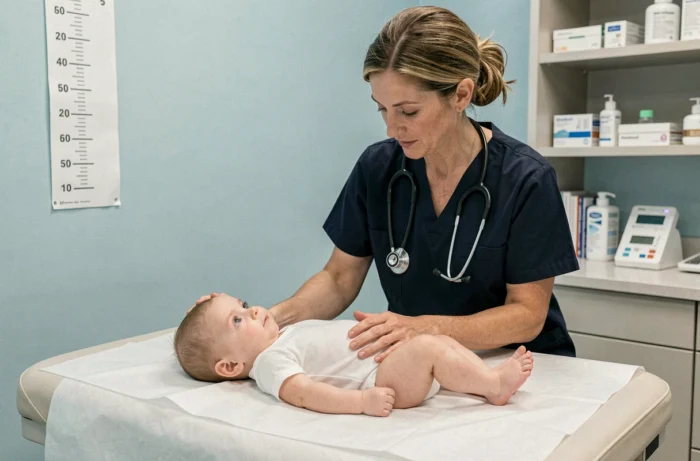
In 2024, HAS published evaluations that reinforce recommendations for coordinated mother-child follow-up. We observe that families who identify their main medical contact before leaving the maternity ward manage the first weeks better, particularly regarding the infant’s weight gain, regurgitation, and transit issues.
Birth Leave 2026: What Changes for Baby’s First Months
The additional birth leave that came into effect in 2026 alters the family organization of the first weeks. Both parents can now be present simultaneously for a longer period after birth, which transforms the distribution of daily care for the infant.
This change has a direct impact on several aspects of early development. The extended presence of the second parent facilitates breastfeeding (the partner manages logistics while the mother focuses on feeding), allows for effective sharing of nights, and reduces the risk of maternal exhaustion, a factor that exacerbates postpartum psychological disorders.
Practically, we recommend planning the leave in coordination with the midwife. The first days at home concentrate most of the learning: cord care, bathing the infant, and securely setting up the sleeping area. Having two available adults during this phase significantly reduces parental stress.
Safe Sleeping and Prevention: Persistent Mistakes
Infant sleeping arrangements remain the area where mistakes are most costly. The baby sleeps alone, on its back, in a firm crib without any additions: no pillow, no duvet, no bumper, no stuffed animals. The room temperature is maintained between 18 and 20 degrees.
The sleeping bag replaces any blanket, with a thickness suitable for the season. In case of fever, the infant is uncovered. These recommendations, regularly reiterated by perinatal networks, remain poorly applied in practice: decorative bumpers and added blankets “just in case” are the most common oversights.
Positional cranial deformation (plagiocephaly) is another point of vigilance. Alternating the orientation of the baby’s head with each sleep and providing supervised tummy time during the day is usually sufficient to prevent this issue, without resorting to a specific pillow.
The first months of an infant require as much medical vigilance as emotional presence. Postnatal follow-up measures exist, but they only work if parents activate them. Knowing their rights to postnatal check-ups, identifying signs of psychological distress, and ensuring safe sleeping arrangements right after leaving the maternity ward are the three pillars of solid support, well before choosing the stroller or the color of the nursery.