
Buying a car based solely on the purchase price and the engine type can lead to quick disappointments. Between the tightening traffic restrictions in low emission zones, the maintenance specifics of electric vehicles, and the difficulty in assessing the actual condition of a battery, choosing a vehicle involves commitments that go well beyond the day of signing.
Repairability of Electric Cars and Access to Spare Parts
Traditional maintenance guides often compare thermal and electric vehicles by limiting themselves to the absence of oil changes or timing belts. This approach masks a more structural problem: the actual repairability of an electric vehicle varies greatly from one manufacturer to another.
A European regulation aimed at improving the repairability of electric cars is currently being developed. The goal is to ensure broader access to spare parts and technical information, including for independent garages. As long as this framework is not fully implemented, some models remain difficult to repair outside the manufacturer’s network, which can increase costs over several years.
Before buying, checking the availability of common parts (brakes, suspensions, electronic modules) with independent mechanics provides a concrete indication. The technical sheets published on mon-guide-auto.fr allow for cross-referencing this data for several models before making a decision.
Electric Vehicle Battery: What the Technical Inspection Does Not Measure
The technical inspection of electric and hybrid cars follows the same schedule as that of thermal vehicles. It includes additional verification points related to high voltage and battery safety. However, it does not measure the residual capacity of the battery, meaning its actual state of health.
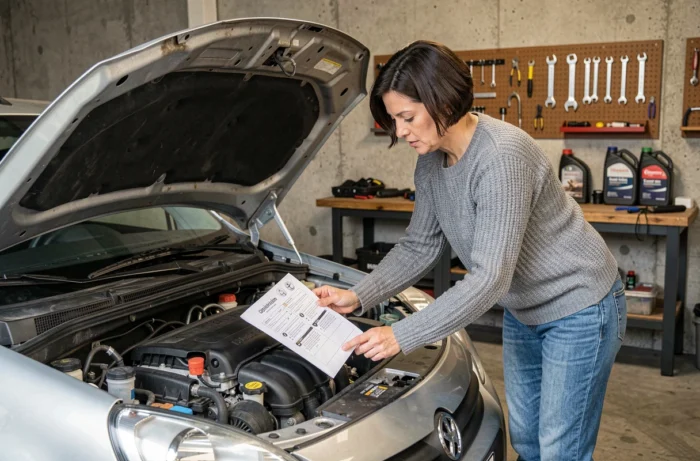
This distinction is crucial when buying used. A vehicle can pass its technical inspection while having a battery whose range has significantly decreased. The inspection checks that nothing poses a visible danger, not that the battery will still hold up for several years of daily use.
To assess this parameter, a specific diagnostic is necessary, often offered by the manufacturer’s network or specialized third-party tools. Field feedback varies on the reliability of these diagnostics depending on the brands, but requesting a battery health report before any used purchase remains the most useful precaution.
Crit’Air Sticker and Low Emission Zones: Anticipating the Vehicle’s Actual Use
Low emission zones (ZFE) now affect several major French urban areas. The ban schedule progresses in stages, depending on the vehicle’s Crit’Air sticker. A diesel classified as Crit’Air 2 or a petrol vehicle classified as Crit’Air 1 can still circulate in most areas, but the trend is towards gradual tightening.
Choosing a vehicle without checking its Crit’Air classification is akin to ignoring a constraint that could render the car unusable in its primary usage area within a few years. Here are the elements to check before purchase:
- The Crit’Air classification of the vehicle and its eligibility in the ZFE of the cities where you regularly drive (home, work, frequent trips)
- The ban schedule planned in your urban area, which can change from year to year based on municipal decrees
- The resale potential of the vehicle if its sticker becomes restrictive, as a vehicle banned in ZFE loses a significant portion of its resale value
For a used purchase, this verification is even more critical. A vehicle priced attractively may be so precisely because its owner anticipates an upcoming restriction.
Regular Maintenance of the Engine and Tires: What Remains Universal
Whether the vehicle is thermal, hybrid, or electric, certain maintenance tasks remain common. Tires, brakes, shock absorbers, and coolant (also present in most electric vehicles) require regular monitoring.
Tire pressure directly influences fuel consumption and road handling. A monthly check prevents uneven wear that reduces tire lifespan and degrades vehicle behavior. In an electric vehicle, the extra weight from the battery accelerates tire wear compared to a similarly sized thermal model.

Following the manufacturer’s maintenance schedule remains the foundation, but it does not cover everything. Actual usage conditions (repeated short trips, humid climate, prolonged outdoor parking) may necessitate more frequent service intervals than those recommended.
- Check the level and condition of the engine oil (thermal/hybrid) or coolant (electric) at each seasonal change
- Have the brake pads checked at least once a year, even if daily driving seems low-stress
- Inspect the condition of the wipers and lighting system before each technical inspection to avoid a re-inspection
Choosing a Car That Will Remain Usable in Five Years
The purchase price, power, or comfort are no longer sufficient to guide a sustainable choice. Cross-referencing the Crit’Air classification, the repairability of the model, and the actual state of the battery provides a more reliable picture of what the vehicle will actually cost over several years.
The available data does not yet allow for certain predictions about which models will be the easiest to maintain in five years. Regulations are evolving, repair networks are adapting, and access to spare parts for electric vehicles remains a developing issue. Integrating these parameters from the outset, rather than discovering them at the first garage visit, remains the most concrete maneuvering room for a driver today.