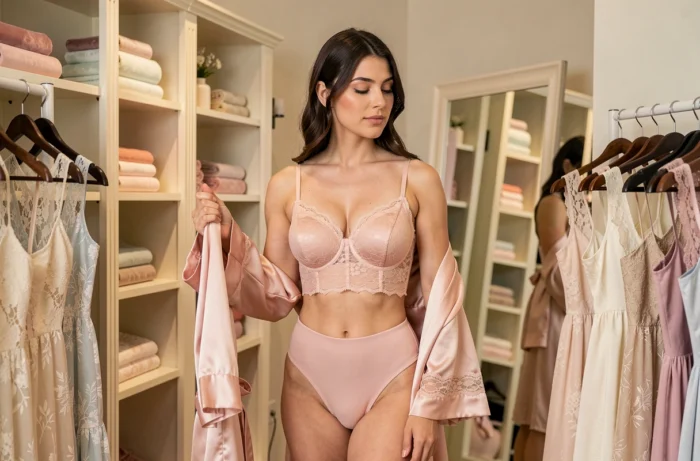
The women’s lingerie market is undergoing a transformation where the criteria for choice evolve well beyond cut and color. In recent years, French regulations have required manufacturers and distributors to provide precise information on the composition, place of manufacture, and environmental impact of textiles. These obligations concretely change what can be verified before purchasing a bra, panties, or a bodysuit.
Textile labeling and lingerie: what the AGEC law changes for choosing underwear
Most lingerie buying guides focus on body shape or style. They overlook a central aspect: product traceability. The AGEC law (Anti-Waste for a Circular Economy) has gradually expanded the information obligations for textiles sold in France.
Specifically, the information now available may include the proportion of recycled materials, the countries of weaving, dyeing, and manufacturing, as well as the recyclability of the product. To compare two balconette bras sold at the same price, this data offers a level of insight that neither lace nor color provides.
Items containing more than half synthetic fibers (polyamide, polyester, elastane) must indicate the potential release of plastic microfibers during washing. However, the majority of common lingerie pieces incorporate a significant proportion of elastane for support, placing them directly within the scope of this obligation.
To explore a wide range of models and compare the characteristics of each piece, specialized catalogs like lingeriefeminine.be allow for cross-referencing technical and aesthetic criteria.

Material composition: polyamide, cotton, lace, and everyday comfort
The comfort of lingerie directly depends on its composition. Field feedback varies on this point: some women prefer cotton for its softness against the skin, while others favor synthetic blends for their ability to support the bust without weighing down the bra.
Lace, often seen as a purely aesthetic choice, also plays a structural role. On a triangle bra or a balconette, it can replace part of the rigid fabric while maintaining light support. Mechanical lace and Calais lace do not offer the same appearance or durability.
Elastane is present in almost all modern lingerie pieces. It ensures the fit at the waist and neckline. However, its proportion in the garment affects the product’s longevity: beyond a certain threshold, the fabric loses its elasticity more quickly after repeated washes.
- Cotton is suitable for sensitive skin and everyday use but offers limited support for fuller busts.
- Polyamide provides lightness and durability, with quick drying after washing.
- Elastane gives the necessary stretch for fit, but its lifespan decreases with high-temperature washes.
- Lace enhances the silhouette and can structure certain cuts (balconette, triangle) without underwire.
Body shape and cut: choosing a bra suited to your silhouette
The choice of cut depends as much on the volume of the bust as on the spacing and height of the placement. A balconette bra, which reveals the top of the neckline, is suitable for medium busts and wide necklines worn under low-cut clothing.
The triangle, without underwire, prioritizes comfort over support. It adapts to smaller busts or days when freedom of movement is paramount. For fuller busts, a wired model with wide straps and a reinforced back remains the most functional choice.
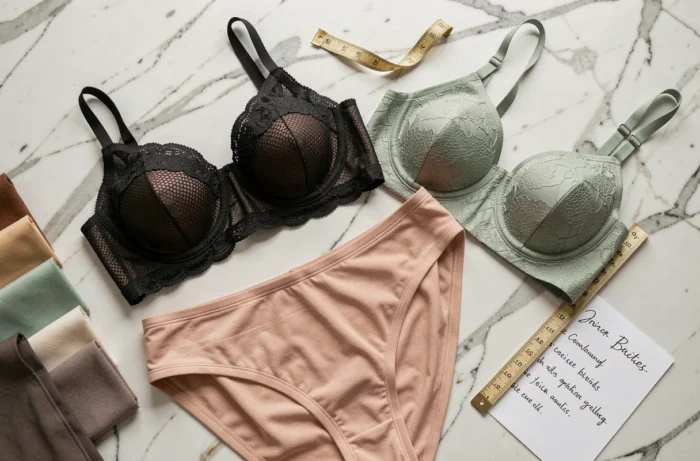
On the panties side, the logic is similar. A high-waisted panty shapes and supports the belly, while a shorty covers more of the buttocks and is suitable for those seeking a compromise between coverage and discretion under fitted clothing.
Fitting and size: common mistakes
A significant proportion of women wear an ill-fitting bra size. The two most common mistakes: a band size that is too large (the band rides up the back) and a cup size that is too small (the fabric compresses the top of the bust).
To check the fit, the finger test remains reliable: one should be able to slide a finger under the band at the back, no more. The center gore should lie flat against the sternum. If not, the cup size is insufficient.
Textile eco-score: an emerging criterion for comparing lingerie
The textile eco-score, currently being rolled out in France, could introduce a new comparison framework for lingerie. This rating system aims to assign an environmental score to clothing, taking into account durability, recyclability, and manufacturing conditions.
The available data does not yet allow for measuring the concrete impact of this score on lingerie purchasing behaviors. Field feedback varies between consumers who claim to pay attention to it and those who prioritize comfort and price as key criteria.
What is certain is that transparency is progressing. Brands that voluntarily provide detailed information about their production chain are already standing out in a market where composition and traceability are becoming differentiating factors alongside cut or color.
- Check for information on the country of manufacture and the exact composition.
- Compare the proportion of recycled materials between two products in a similar range.
- Consider the mention of synthetic microfibers for items with a high proportion of polyamide or polyester.
The choice of suitable lingerie now relies on a triptych that goes beyond mere visual appeal: the cut suited to one’s body shape, the composition of materials according to one’s lifestyle, and the clarity of environmental information provided by the manufacturer. These three axes do not exclude each other; they complement each other with every purchase.