A productive vegetable garden in January as in August relies less on the number of hours spent outdoors than on a few technical choices made at the right time. The soil, water, planting calendar, and management of the local climate form a system where each element conditions the others. Succeeding in your vegetable garden all year round is primarily about understanding this system to intervene little, but in the right place.
Living soil and permanent mulching: the foundation of a productive vegetable garden
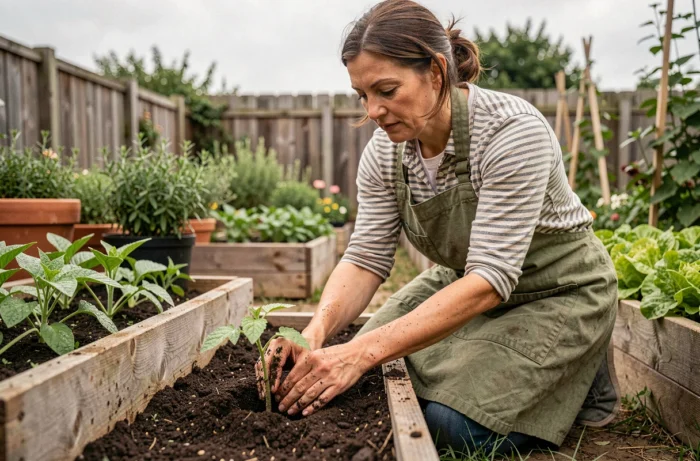
Before discussing sowing or varieties, look at what is happening under your feet. A bare, compact soil absorbs water poorly, heats up quickly in summer, and compacts under rain. In contrast, a permanently covered soil retains moisture and nutrients without constant intervention.
Permanent mulching is the simplest lever to achieve this. Straw, hay, dead leaves, dried grass clippings: the layer placed on the ground nourishes the worms and microorganisms that structure the soil for you. In winter, this mulch also protects the roots from frost.
Compost complements the system. Spread on the surface in autumn, it decomposes slowly and enriches the soil without tilling. This approach, often summarized under the term “living soil,” changes the logic of gardening: rather than adding fertilizers each season, you build lasting fertility. To delve deeper into these techniques, L’Herbe sous le Pied’s vegetable garden guide details the implementation steps suited to each type of soil.
Sowing calendar and crop rotation in the vegetable garden
You may have noticed that some vegetables sown in March stagnate for weeks, while others planted at the end of April catch up in just a few days? The soil temperature matters more than the date on the calendar.
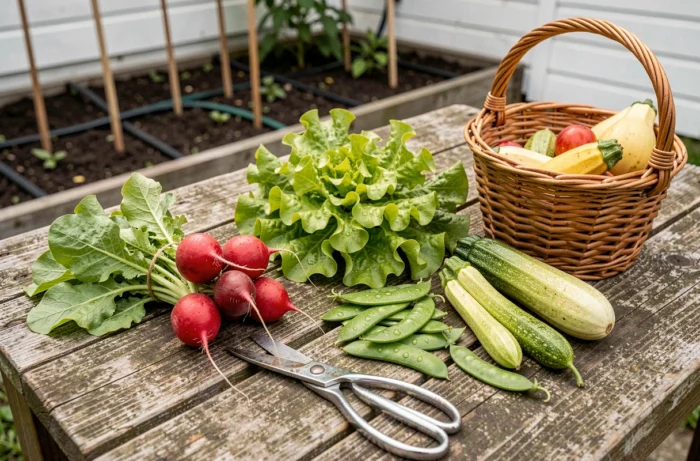
Lettuce, radishes, and spinach tolerate still-cool soil and can be sown as early as the end of winter. Tomatoes, zucchinis, and beans need warmed soil, usually from mid-May in the northern half of France. Sowing too early exposes the seeds to fungal diseases and soil insects.
Staggering sowings for continuous harvest
Sowing the same variety every three weeks avoids the production peak followed by a gap. Apply this principle to green beans, lettuces, and radishes to maintain a steady harvest from spring to autumn.
Why alternate vegetable families
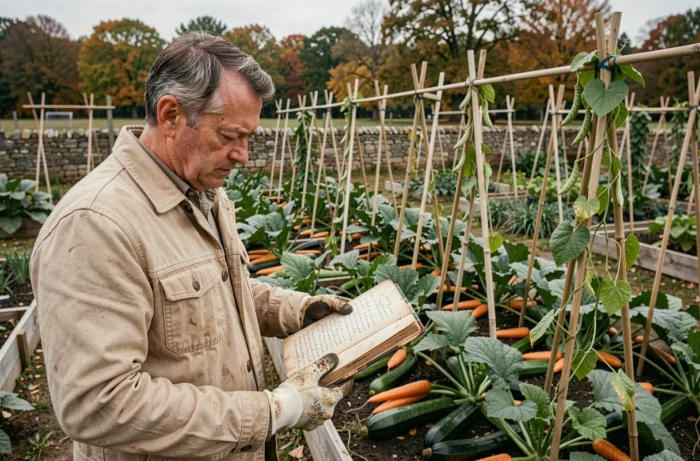
Crop rotation involves not replanting the same family of vegetables in the same spot two years in a row. Tomatoes, peppers, and eggplants (nightshade family) draw the same nutrients and attract the same pests. Alternating them with legumes (beans, peas, broad beans) allows you to naturally restore nitrogen in the soil, as these plants fix atmospheric nitrogen into the ground.
A simple plan in four zones, where each family rotates one location each year, is sufficient for a family vegetable garden:
- Zone 1: fruiting vegetables (tomatoes, zucchinis, cucumbers) that require rich soil
- Zone 2: root vegetables (carrots, beets, turnips) that prefer loose, minimally amended soil
- Zone 3: legumes (peas, beans, broad beans) that enrich the soil with nitrogen
- Zone 4: leafy vegetables (lettuces, spinach, cabbages) that benefit from the nitrogen left by the legumes the previous year
Watering the vegetable garden: saving water without sacrificing harvests
Watering often represents the most time-consuming task in the garden. Watering more does not solve anything if the water evaporates before reaching the roots.
Watering at the base, early in the morning, significantly reduces evaporation. The water penetrates still-cool soil and reaches the deep roots. Sprinkling in full sun wastes a considerable amount of water and promotes fungal diseases on the foliage.
Collecting rainwater for the vegetable garden
The decree of July 12, 2024, has consolidated the regulatory framework for the use of water unsuitable for human consumption, including rainwater, for watering vegetable gardens. Under sanitary and technical conditions, watering your vegetable garden with collected rainwater is permitted, which secures the practice during periods of restrictions.
In case of drought, prefectural orders distinguish between ornamental uses (lawns, decorative beds) and food uses. The vegetable garden generally benefits from a broader tolerance, with the possibility of watering outside of hot hours rather than a total ban.
Adapting your vegetable garden to extreme weather events
Prolonged heatwaves, late frosts in April, intense rains: the classic gardener’s calendar is no longer sufficient. Adaptation involves creating microclimates within the vegetable garden itself.
A south-facing wall accumulates heat and releases it at night, protecting crops sensitive to cold. Conversely, in summer, tall plants (sunflowers, corn, pole beans) create shade for lettuces and spinach that bolt as soon as the temperature exceeds a certain threshold.
Choosing varieties suited to your region
Local and heirloom varieties often withstand climatic fluctuations better than hybrids selected for productivity in suitable conditions. A tomato suited to your terroir may produce less per plant, but it will better withstand a heat episode without additional irrigation.
Mulching, again, plays a buffering role against extremes. In summer, it keeps the soil cool. In winter, it limits surface frost. A permanently mulched vegetable garden goes through the seasons with fewer losses than a worked soil left bare between two crops.
- Install a winter cover over winter vegetables (leeks, spinach, lamb’s lettuce) as soon as frost is forecast
- Mulch with at least ten centimeters of organic material to cushion soil temperature variations
- Plant low hedges or rows of aromatic plants (rosemary, lavender) as natural windbreaks around exposed plots
A vegetable garden that works all year round does not require more work, but work placed better. Nourished soil, managed water, staggered sowings, and exploited microclimates form a coherent whole where each action reinforces another. Consistency matters more than intensity.