
Each new season brings its share of pieces and silhouettes highlighted on the runways, but the autumn-winter 2026 season stands out due to a French regulatory framework that directly alters the cost of certain garments. Comparing the fashion trends of the season without considering this context is akin to ignoring a variable that impacts the budget and consumer choices.
Penalty on ultra-fast fashion and the real cost of trendy pieces
A financial penalty targets items from ultra-ephemeral fashion in France. Published by the Ministry of Economy, the scheme imposes a penalty per garment for the affected pieces. Second-hand items are exempt from the penalty, and the scale will be gradually tightened until 2030.
At the same time, the law adopted in July 2026 prohibits advertising for ultra-ephemeral fashion starting in 2027, along with obligations to inform about social and environmental impacts and the place of manufacture. This dual constraint, first fiscal and then advertising, will reshape the displayed prices from the next collections.
| Criteria | Ultra-ephemeral fashion (new) | Standard brands (new) | Second hand |
|---|---|---|---|
| Applicable penalty | Yes, amount per piece | Not affected | Exempt from penalty |
| Advertising allowed (2027) | Prohibited | Allowed | Allowed |
| Manufacturing information obligation | Yes (law July 2026) | Partial depending on company size | Variable depending on platform |
| Projected market growth | Hindered by legal framework | Stable | 2 to 3 times faster than new |
The table highlights a clear gap: following fashion trends on Blog Too or other specialized media allows you to spot seasonal pieces without falling into the segment penalized by the penalty.

Second hand and autumn-winter 2026 trends: a concrete arbitration
The resale market is growing two to three times faster than the first-hand market. This growth differential transforms the way a seasonal wardrobe is built.
Several key pieces of autumn-winter 2026 are particularly well-suited for resale purchases:
- The structured blazer, a naturally durable piece, is easily found on second-hand platforms in sought-after materials and cuts this season
- The straight jeans or fluid pants, two cuts highlighted for the 2026 back-to-school season, retain their usability value over several seasons and are actively circulating in resale
- Knitwear pieces (sweaters, cardigans) benefit from an abundant stock in second hand as soon as the first cold hits, often at a fraction of the new price
Conversely, some more niche trends (strong prints, seasonal colors like deep burgundy or chocolate) remain harder to find in resale, as their availability depends on past collections. For these specific pieces, purchasing new from standard brands unaffected by the penalty remains the most straightforward option.
Seasonal colors and materials from a sustainability perspective
Burgundy, khaki, ecru, chocolate: these key colors of autumn-winter 2026 do not all offer the same stylistic longevity.
Neutral tones (ecru, khaki, chocolate) withstand trend cycles better than highly saturated shades. A chocolate coat or khaki pants bought this autumn will retain its stylistic relevance the following season. Burgundy, a strong color for the 2026 back-to-school season, poses a risk of quicker fatigue if the piece is very visible (coat, dress).
On the materials side, the July 2026 law imposes obligations to inform about the environmental and health impacts of products. Brands will gradually need to communicate about the composition and origin of their textiles. Prioritizing traceable materials becomes a selection criterion on par with cut or color.
Building an autumn-winter 2026 look with the right new-second hand ratio
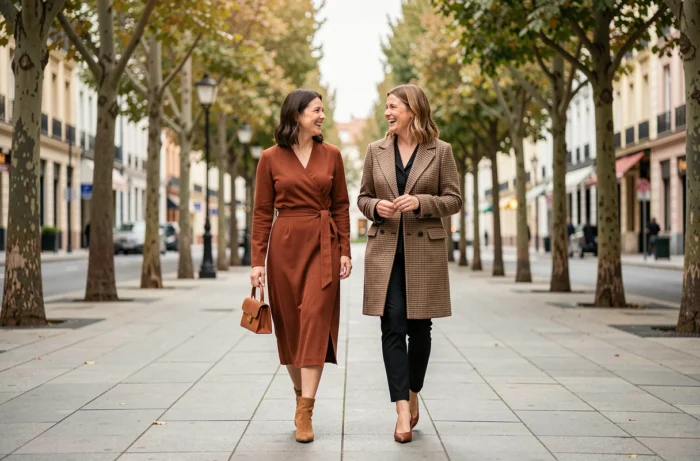
Rather than a list of pieces to accumulate, the seasonal data invites thinking in terms of ratio. The logic is simple: durable basics (blazer, straight jeans, solid knitwear, coat in a neutral tone) should first be sought in second hand. Pieces with strong seasonal identity (revisited floral print, burgundy dress, highly typified accessory) should be bought new if they cannot be found in resale.
This reasoning is not only economic. With the expected tightening of the penalty until 2030, the cost of a 100% new and ultra-ephemeral wardrobe will mechanically increase each year. The resale market, exempt from the scheme, absorbs part of the demand for classic style pieces.
The circular fashion index 2026 published by Kearney confirms this trajectory: circularity is no longer a marketing argument, it becomes a structural parameter of the textile market. Consumers who integrate this data into their seasonal choices build a more resilient style, both aesthetically and financially.
The French legal framework now weighs as much as the runway shows in the composition of an autumn-winter 2026 wardrobe.