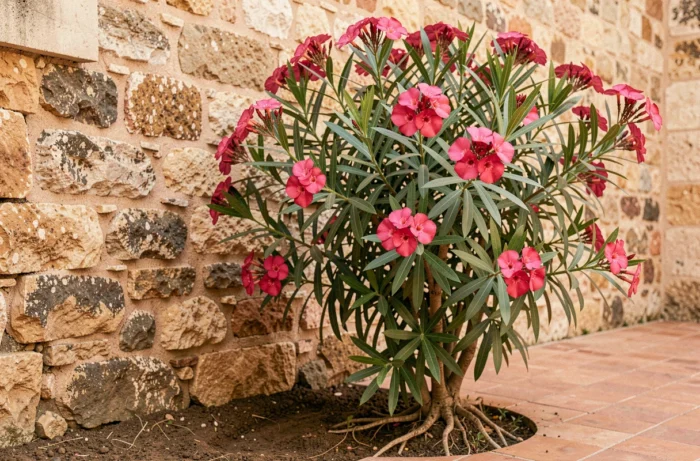
The oleander attracts attention with its long flowering period and evergreen foliage, but the question of its impact on a wall or foundations deserves to be raised with precise data. Several parameters come into play: the actual depth of the roots, the nature of the soil, the setback distance, and the regulatory framework. This article compares these variables to determine in which configurations the risk really exists.
Root depth of oleander compared to risky species
The first instinct is to position the oleander in relation to trees that are actually reported as problematic for constructions. Risk assessments of root systems relayed by specialized press citing Géorisques.gouv.fr do not mention oleander among the species to watch.
| Species | Type of roots | Common depth | Reported as foundation risk |
|---|---|---|---|
| Poplar | Extensive, spreading | Several meters | Yes |
| Weeping willow | Extensive, high water demand | Several meters | Yes |
| Robust fig | Powerful, spreading | Several meters | Yes |
| Running bamboo | Horizontal rhizomes | Variable, strong lateral spread | Yes |
| Oleander | Fasciculate, not aggressive | 30 to 90 cm | No |
The roots of oleander generally develop between 30 and 90 cm deep. This level remains lower or comparable to the common depth of foundation footings for a single-family home, estimated around 60 to 100 cm.
The question that arises does not have a universal answer. Before planting an oleander near a wall, it is essential to analyze the local context, particularly the nature of the soil.
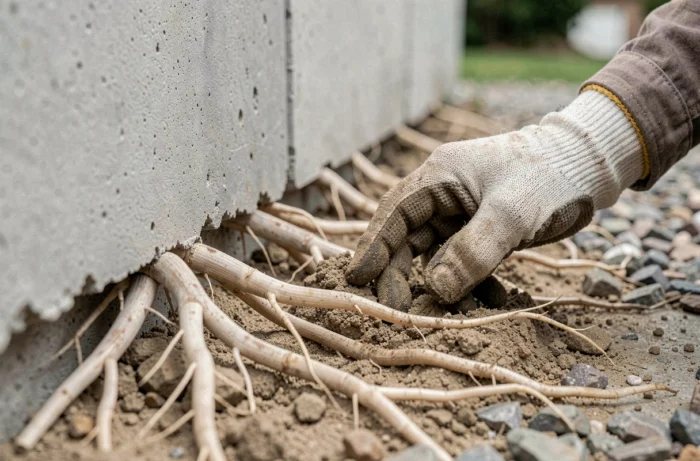
Clay soil near a wall: the game-changing factor
The majority of damage to foundations does not come directly from the mechanical pressure of the roots. The main mechanism is the shrink-swell of clays, amplified by the water absorption of nearby plants.
A shrub planted in clay soil can dry out the ground down to the depth of the foundations. Experts in building cracks then recommend a setback much greater than the distances usually cited.
Setback distance on clay soil according to crack experts
Competing content often mentions a distance of one to two meters. Building specialists apply a stricter rule: a distance at least equal to the adult height of the plant. For species with high water demand, this distance increases to 1.5 times the adult height.
An oleander easily exceeds two meters in favorable climates. On clay soil, this leads to a setback of around three meters or more when the house is sensitive to ground movements.
- On draining soil (sandy, loamy), a setback of one to one and a half meters is generally sufficient for a medium-sized oleander.
- On clay soil with healthy foundations, a setback equal to the expected adult height limits the risk of differential drying.
- On clay soil with existing cracks or buried pipes nearby, the recommended setback reaches 1.5 times the adult height, which is about three meters for a vigorous specimen.
How to identify clay soil
In the absence of a geotechnical study, a simple test involves taking a handful of moist soil and rolling it between your fingers. Clay soil forms a pliable roll that does not break easily. Maps of clay shrink-swell exposure, available online at Géorisques, provide parcel-specific indications.
Planting distances for oleander: Civil Code and boundary limits
Regulations also govern the planting distance in relation to property boundaries. Article 671 of the Civil Code imposes a minimum distance of two meters for plantings exceeding two meters in height. Below this size, the distance reduces to 50 cm.
For an oleander trimmed to a height under two meters, planting 50 cm from the boundary remains legal. However, a specimen left to grow freely often exceeds this height and then requires a setback of two meters from the neighbor’s fence.
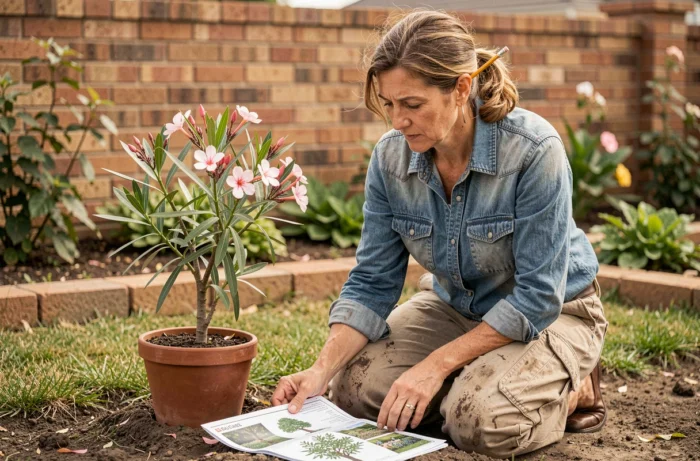
Article 673 of the Civil Code also allows a neighbor to cut roots encroaching on their property, which can damage the shrub if planted too close. This practical risk adds to the structural risk.
Protecting an existing wall during planting
When the setback distance remains limited (less than two meters), additional measures reduce interactions between roots and masonry.
- Install a high-density polyethylene root barrier between the planting hole and the wall, buried at least 60 cm deep.
- Drain the foot of the wall with a gravel bed to avoid sudden water variations in the soil in contact with the foundations.
- Prefer a dwarf or semi-dwarf variety, whose adult height remains under one and a half meters, which proportionally reduces root spread and water consumption.
- Plant in a large-volume raised bed if the wall has cracks or if the soil is identified as clay, which eliminates any root contact with the natural ground.
Container gardening remains the safest solution when multiple risk factors accumulate (clay, cracks, pipes). It requires more regular watering and fertilization but eliminates the root problem at the source.
The oleander is not among the species dangerous to foundations, and most plantings in draining soil with a one-meter setback pose no problem. The only truly risky scenario combines clay soil, shallow foundations, and insufficient distance. On clay, applying the rule of setback equal to the adult height protects both the wall and the shrub.